

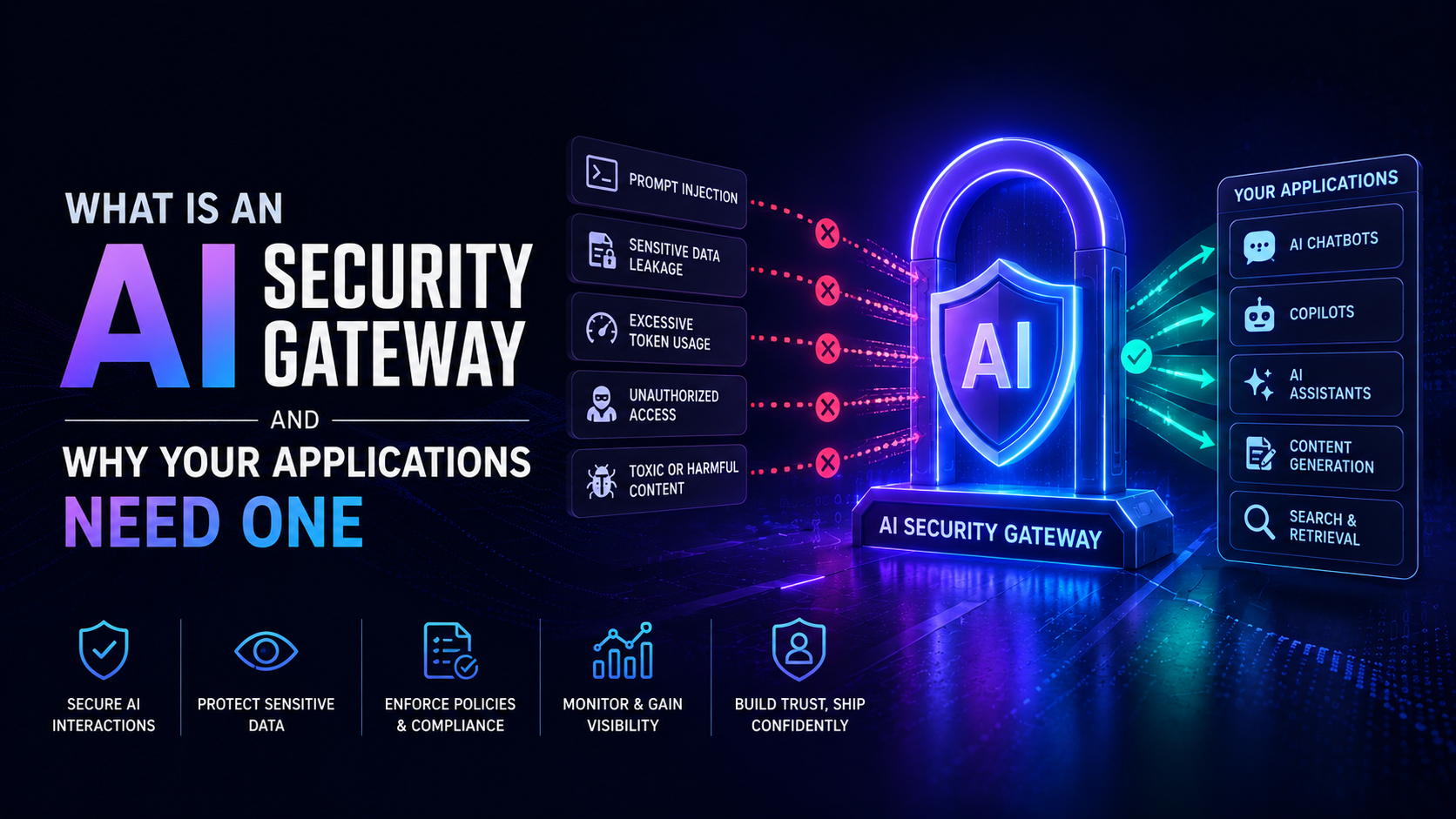
What Is an AI Security Gateway and Why Your Applications Need One
Artificial intelligence has moved from roadmap item to core infrastructure. Chatbots handle customer queries; copilots assist internal teams, and autonomous agents execute multi-step workflows with minimal human oversight. AI is no longer adjacent to the product; it is the product.
That shift brings a problem most security teams haven't caught up with the tools built to protect traditional software that were never designed to protect AI. And the gap between what legacy security covers and what AI actually needs is where attackers are operating right now.
The attack surface AI creates
Unlike traditional software bugs, AI vulnerabilities live in behavior, not code. You can't patch a prompt injection the way you patch a SQL injection. You can't sign a signature-match data leakage that looks identical to a valid API response.
Traditional firewalls, WAFs, and SIEMs inspect traffic and match signatures. They have no concept of intent, context, or model behavior. Against AI-native attacks, they are essentially blind. The threats are real: prompt injections that hijack model behavior, sensitive data surfaced through responses unintentionally, unauthorized API abuse that drains budget, and autonomous agents executing unintended actions under adversarial inputs.
"A firewall protects your network. An AI Security Gateway protects your model's behavior. They solve fundamentally different problems."
What an AI Security Gateway does
An AI Security Gateway is a protective layer that sits between your AI systems and the outside world. It inspects every interaction in real time, enforces your security and compliance policies, and stops threats before they reach or leave your model. It operates across three stages:
Input protection - Every incoming prompt is analyzed for injection attempts, malicious intent, and policy violations before the model ever sees it.
Processing oversight - Model behavior is monitored in real time. Anomalies, reasoning deviations, and unexpected patterns are flagged as they happen.
Output filtering - Every response is validated before delivery. Sensitive data is redacted. Non-compliant content is blocked. Nothing leaves unchecked.
How Vigilnz approaches this differently
Most gateway solutions rely on static detection rules. Vigilnz takes an agentic approach: intelligent security agents that continuously monitor your AI systems, detect threats through contextual understanding, and adapt to new attack patterns automatically without manual rule updates or intervention.
As AI adoption scales, so does the sophistication of attacks against it. Security built on rules written last quarter cannot keep pace. Vigilnz was designed for a threat landscape that evolves daily.
If your product runs on AI, a dedicated security layer is no longer optional. The question is whether you build it in from the start, or scramble to add it after something breaks.
Vigilnz securing AI, the right way.
Get Started with Vigilnz